Implement of Erasure
At Toys “R” Us, I skip straight to the aisle with the Rite Hite stove to find my own image on the box—blue, smocked dress, black patent leather shoes. Or turn to the ad in Harper’s Bazaar on the coffee table and smile back at myself, wrapped in a faux fur coat. Only girl, baby of the family, my room is shag-carpeted and pink-pillowed.
Michael lives at a “special school,” and I picture him at a desk in a classroom like my own, with a blackboard and felted erasers. Unlike my other brothers, I have not helped care for him or felt the weight of whispers in public. They’ll tell me later how our parents bickered about cleaning up shitballs under the bed.
I balk at attending the funeral and no one presses. A neighbor babysits, we play endless rounds of Chutes and Ladders. Each week, my mother drives me into Manhattan for casting calls, photo shoots, where I smile on cue, no fidgeting. She reads with me, quizzes me on spelling words, puffs up at my gold stars from school.
♮
Farewell at Varanasi
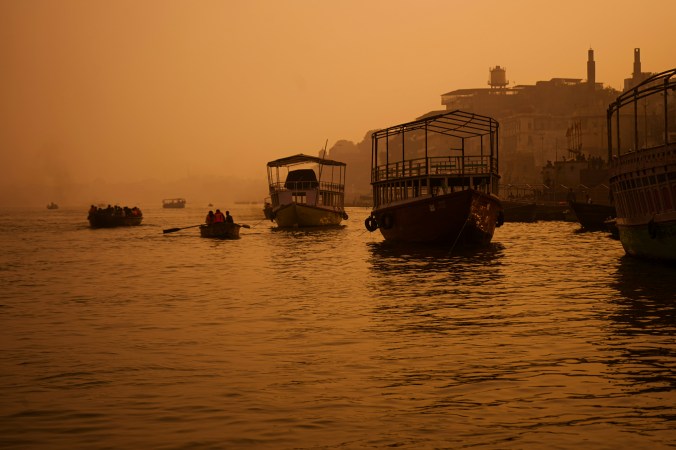
A slender girl in rumpled clothes lifts the votives toward me: each a splotch of wax, snip of string, sprinkle of petals, nestled in a weave of dried leaves. She boards our weathered rowboat, collects 100 rupees, places three into my open palms, and leaps the gap to the embankment. A gift, this bridge in this hallowed place, eight-thousand miles from home.
Upriver on the Ganges, open pyres smolder on the cremation ghats, stacked with felled trees, six-hundred pounds per body. Sons and brothers carry the litters overhead, the dead wrapped in orange and marigold, silks and garlands, parting the crowds in ancient, narrow streets. Families stream behind—only the strong who won’t weep, our guide tells us, meaning only the men.
I think of our father in 1972, solemn on an airplane, deciding where to stow your remains. He will bury your ashes in a family plot in your birthplace, distant from our home. There will be no marker—because you are still a child? Because it was too expensive? Because your disability was the source of family shame? I won’t be able to form those questions until it is too late to ask. I met you only once, in the institution, and I’m not sure we ever even touched.
The smell of death drifts toward us, bitter with ashflake, swirls into the veil of mist that gathers over Mother Ganges. We push off, opposite bank shrouded. The holy man drapes beads around our necks, smears turmeric and vermillion on our foreheads, chants a blessing. Women pound laundry on the stone stairs. Pilgrims strip down to underclothes, immerse, shed their sins. They fill bottles with the murky, holy water they will cushion inside shoes and pack into their suitcases.
Fog soon swallows the sadhus and snake charmers, tourists and pilgrims, beggars and open-air barbers. We can just see the shaggy outline of larger boats, engines threaten in the distance, our oarsman debates our guide about direction. I open my GPS, squint, try to discern East from West. It has taken an ocean of time and distance, a certain dislocation, to be ready for ceremony.
I find the candles lined up on the bench seat and set the first two afloat—for our father, my sister—taking pains not to touch the water. The current churns, swirls them away. The last—for you, my brother—is slow to catch. Cupping my hand, I lean over the edge, whisper your name, let go. My fingers skim the river—sacred, black—as I release the tiny flame. This time I let my fingers drag, cool and wet.
In our dream band, on flute:
Kristin W. Davis (kristinwdavis.com) has writing published or forthcoming in Nimrod, The Los Angeles Review, Arts and Letters, and the Maine Sunday Telegram, and on the Split this Rock blog and Maine Public radio. Her work is a 2023 finalist for the Pablo Neruda Poetry Prize and earned the International Human Rights Arts Festival’s Creators of Justice Award. She holds an MFA from the University of Southern Maine, Stonecoast, and lives in Washington, DC.
 Ran Off With the Star Bassoon